

Summary
The Great Western Railway’s first passenger station in Toronto was built in 1855 near the present location of the Sir Isaac Brock Bridge. This coincided with the construction of the Great Western’s Toronto Branch – now the Lakeshore West Line – which opened to rail traffic on December 3rd, 1855. The Great Western also built a freight shed and a roundhouse nearby. The freight shed was responsible for handling freight from businesses in Toronto who were unable to get direct rail service. In addition to the storage and maintenance of locomotives, the Great Western roundhouse’s turntable was necessary to flip locomotives around as Toronto was the end of the line. Upon the opening of Toronto’s first Union Station on June 21st, 1858, the Great Western began using it as their main passenger terminal instead. The original station was then disused and dismantled shortly thereafter.
Toronto’s first Union Station soon proved inadequate to handle the volume of passengers and the Great Western set out to establish its own terminal at Yonge Street, which opened to passengers on March 2nd, 1866. It was specifically situated at the corner of Yonge Street and The Esplanade, which is where the main rail corridor east of Union Station was situated at the time. The station was oriented diagonally to The Esplanade, having a semicircular roof with two portals at one end for four tracks to enter from only one side. Its most striking feature was the arched train shed with a circular galvanized iron roof. A sign reading “Great Western Railway” spanned the top of both portals. A series of eight arched windows on the Yonge Street side of the shed, as well as a continuous series of smaller windows running along each side of the shed, provided excellent lighting. This was the first passenger train station in Toronto to provide total shelter for passengers on the platforms. On the south side of the structure was a spacious freight shed and office, while the north side contained the passenger facilities. The latter included separate waiting rooms for men and women, a telegraph office and a refreshment room. Under the flat roof connecting the passenger facilities with the train shed were the baggage facilities and a platform 195 feet long and 36 feet wide. Under the flat roof connecting the passenger facilities with the train shed were the baggage facilities and a platform 195 feet long and 36 feet wide. Its prime location near Toronto’s Victorian-era financial district made it the most conveniently-placed railway station in the city upon its opening. The Ontario Parliament buildings were located on Front Street three blocks west of the station, and it was also in the vicinity of numerous hotels and several ferry and steamboat docks on Lake Ontario. By 1867, a total of ten trains arrived and departed the Great Western station each day. While the Great Western Railway would no longer be a tenant of Union Station, they would continue to stop their trains nearby as a convenience for passengers.
The Yonge Street station continued serving passengers until 1882 when the Great Western was acquired by the larger Grand Trunk Railway. Subsequently, the Yonge Street station was closed to passengers and converted into a bonded freight depot. To reflect the change in ownership, the “Great Western Railway” lettering above the train shed was replaced with “Grand Trunk”. The former station continued to be used in this capacity until 1896, and the building was sold off to a new private owner in 1904. It was converted once more into the Toronto Wholesale Fruit Market, which utilized the existing tracks into the building to take shipments of fruit by rail. Pacific Fruit Express reefer cars were consistently seen on the Esplanade at Yonge Street for many decades afterward as a result. The lake was filled in south of the Esplanade in the 1920’s, and the tracks leading into the former station building were subsequently removed and replaced with a loading dock for trucks. Unfortunately, a devastating fire tore through the building on May 17th, 1952, rendering it unsalvageable. The remnants were dismantled shortly thereafter and the O’Keefe Centre for the Performing Arts opened on the site in 1960. More recently, a large condominium tower was built on top of the area the station was located.
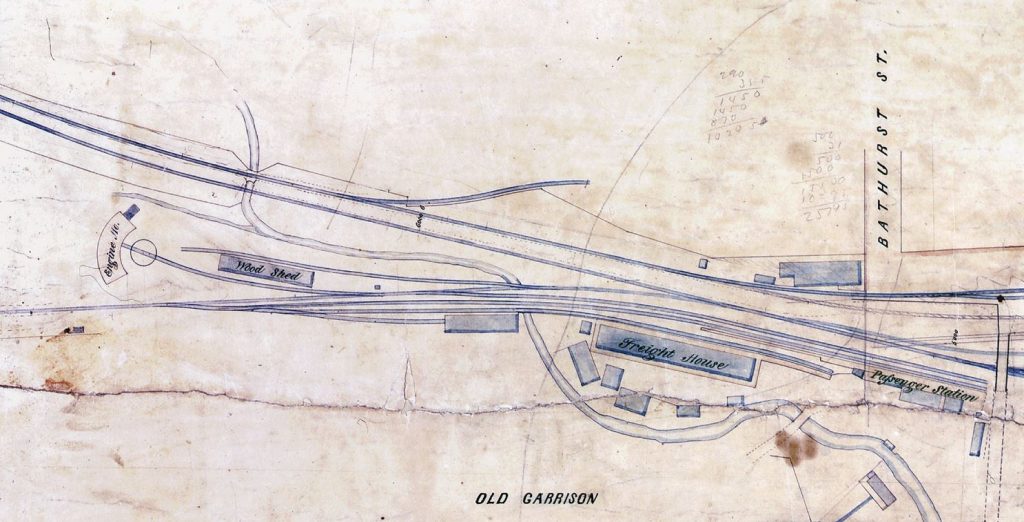
A circa 1859 map showing the Great Western Railway’s first passenger station at Bathurst Street, seen at right. Courtesy of Library and Archives Canada. 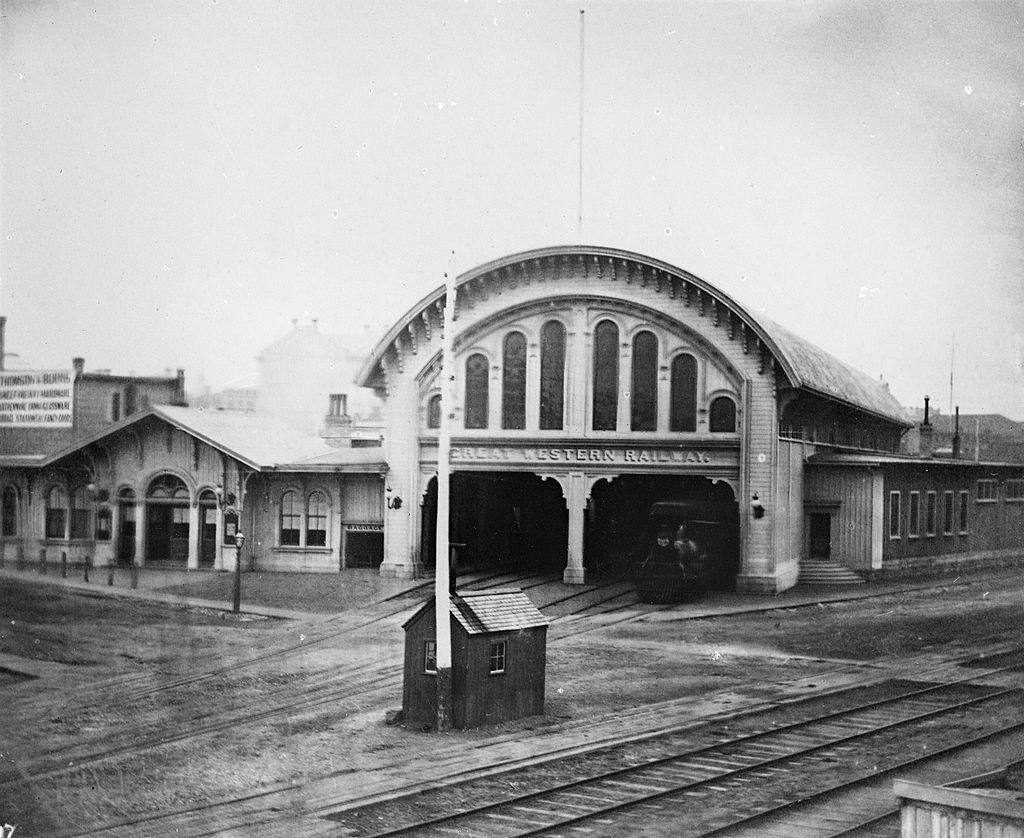
An 1867 photograph of the Great Western station at Yonge Street in Toronto, approximately one year after it was built. Courtesy of the Toronto Public Library. 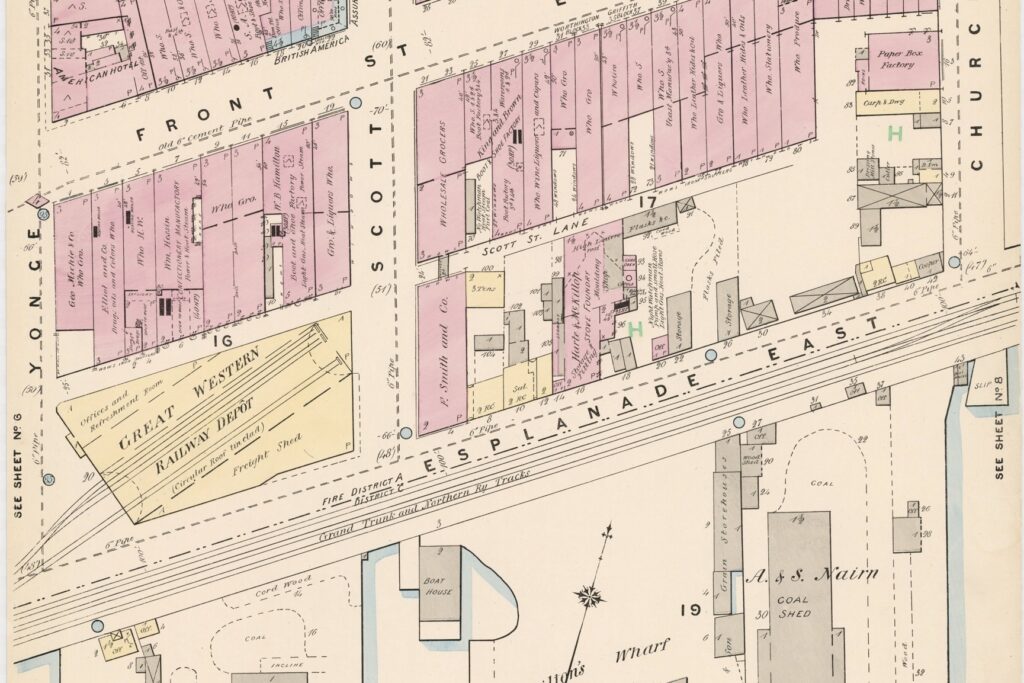
An 1880 map showing the 1866 Great Western station towards the bottom left, situated between Scott and Yonge Streets. 
By the early 1900’s, the lettering has changed to reflect its new owner and now only freight cars fill the platform tracks. 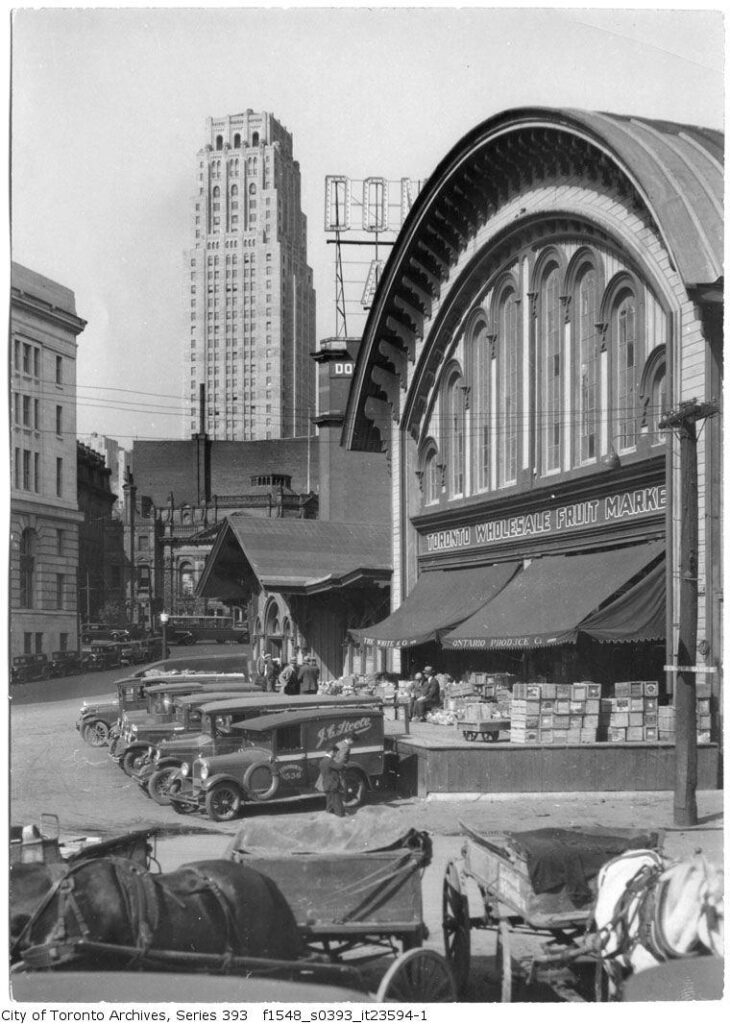
A 1931 photograph shows the former Great Western station in its new life as the Toronto Wholesale Fruit Market. The Canadian Bank of Commerce Building rises from the background, then the tallest building in the Commonwealth. Courtesy of the City of Toronto Archives. 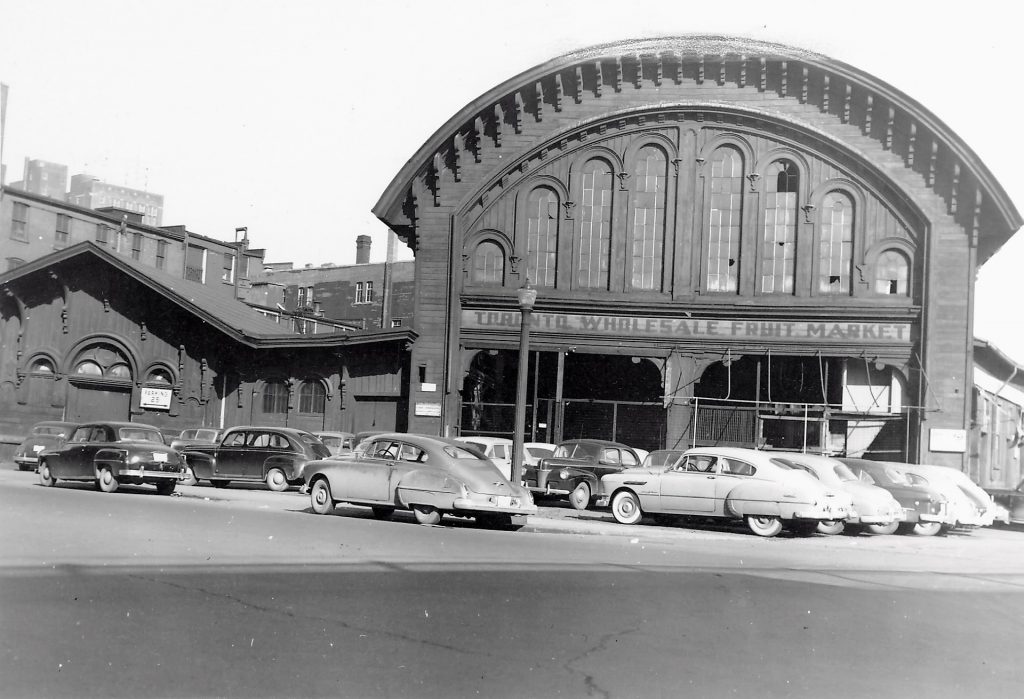
A 1951 photograph of the former Great Western station just a year before it was destroyed by fire. Courtesy of the Toronto Public Library. 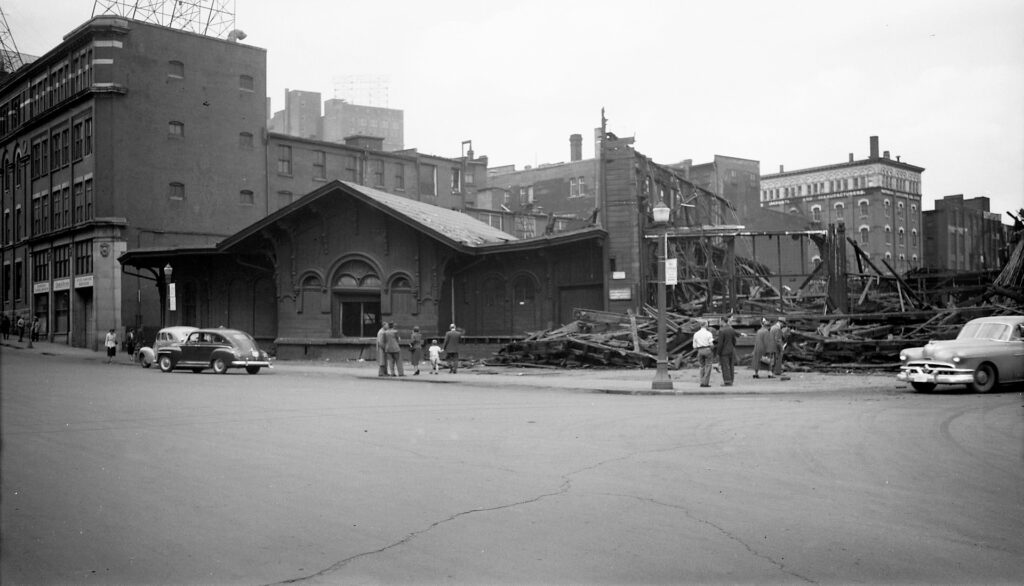
An image from 1952 shows the extent of the fire damage to the former Great Western station. Courtesy of the Toronto Public Library.
Condensed Station Info:
| Location: | Served By: | Current State: | Date Built: | Date Demolished: |
| Bathurst Street (First) Yonge & Esplanade (Second) | Great Western Railway (1855 – 1858, 1866 – 1882) | Demolished (First) Burned Down (Second) | 1855 (First) 1866 (Second) | 1858 (First) 1952 (Second) |