

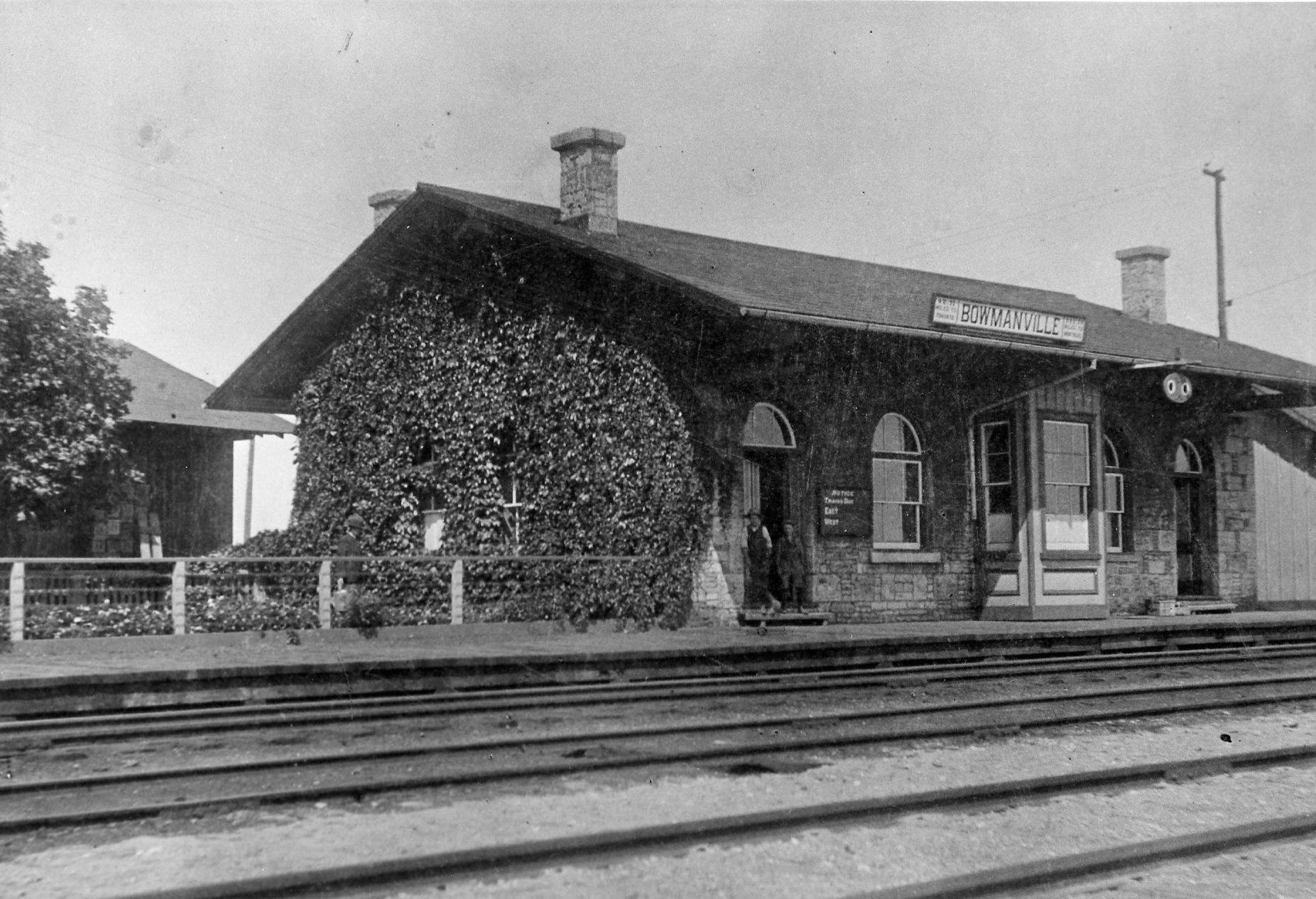
On This Day: Grand Trunk Railway Opens from Montreal to Toronto
Today marks 170 years since the Grand Trunk Railway first opened between Montreal and Toronto, on October 27th, 1856. Special passenger trains departed simultaneously from each end of the line and met in the middle at Kingston, where a brief ceremony took place. These trains departed and arrived at what was intended to be a temporary station between the Don River and Cherry Street, which a firsthand account described as a “substantial structure of stone”. The Grand Trunk east and west of Toronto had to be built separately at first. Their only means of navigating Toronto’s waterfront, the Esplanade, was still under construction when the Toronto – Montreal line opened. You can read more about the Grand Trunk’s temporary station and the history of rail on the Esplanade at these links.
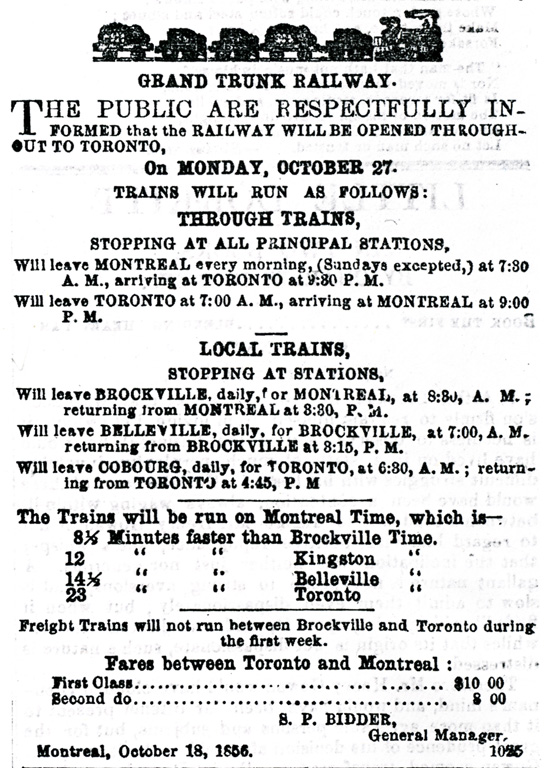

Unlike most other railways in Canada up to that point, which were mostly isolated branches connecting smaller towns and existing water routes, the Grand Trunk Railway was envisioned as a proper intercity railway connecting what were then the Province of Canada’s two largest cities. The idea of such a railway began to emerge in the 1840’s but the necessary financial and political backing did not materialize until the following decade. When William Dawson, geologist and principal of McGill College in Montreal made the fastest possible journey to Toronto in 1855, he noted that it took him five days and involved switching between stagecoaches and steamships at least a half dozen times. Shortly after the Grand Trunk opened, Dawson became one of its first passengers and the journey now took him just 14 hours.
One of the main benefits of the Grand Trunk was that it offered all-season travel, with some exceptions in the event of severe weather. Steamship travel across Lake Ontario and up the St. Lawrence was only viable for a handful of months out of the year. When the lake froze over, your only hope was the road connecting Toronto and Montreal, a precursor to the modern-day Highway 2. The poor condition of this road made travel slow and perilous at times, and often impossible during winter. Though winter also took its toll on the Grand Trunk early on, it still offered the best and sometimes the only way to get between Toronto and Montreal for a few months out of the year. By 1858, the Grand Trunk rostered a total of 34 snow plows dedicated to clearing the right-of-way after heavy snowfall. Many of the GTR’s earliest enginehouses (including two in Toronto) featured fully-enclosed turntables to keep them sheltered from the elements during winter.
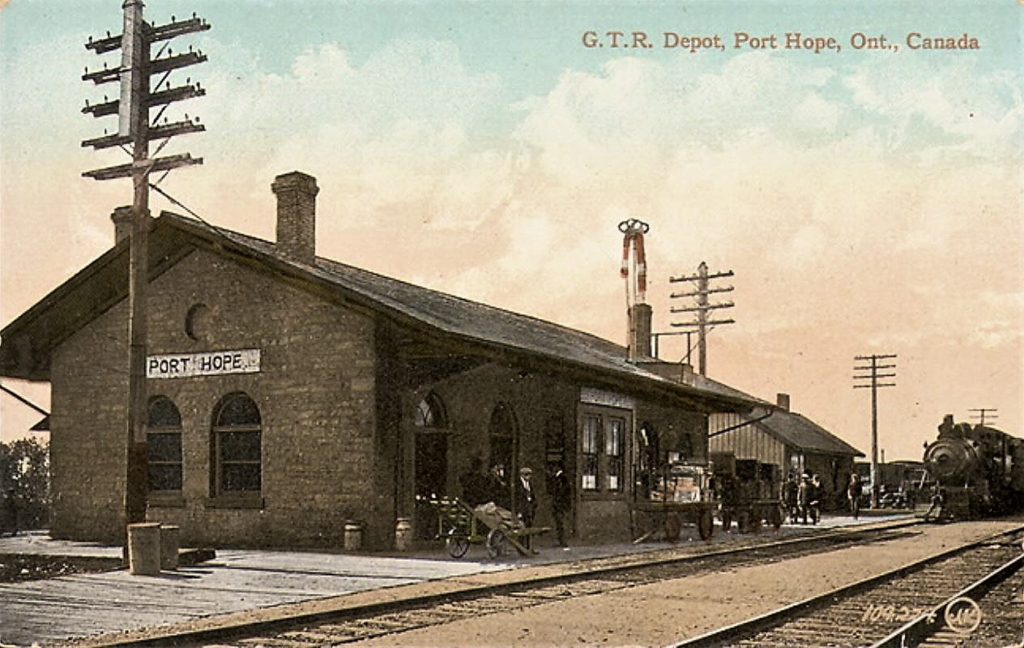
A 1913 postcard of Port Hope’s Grand Trunk station, which was present for the 1856 opening of the line. Courtesy of the Toronto Public Library. 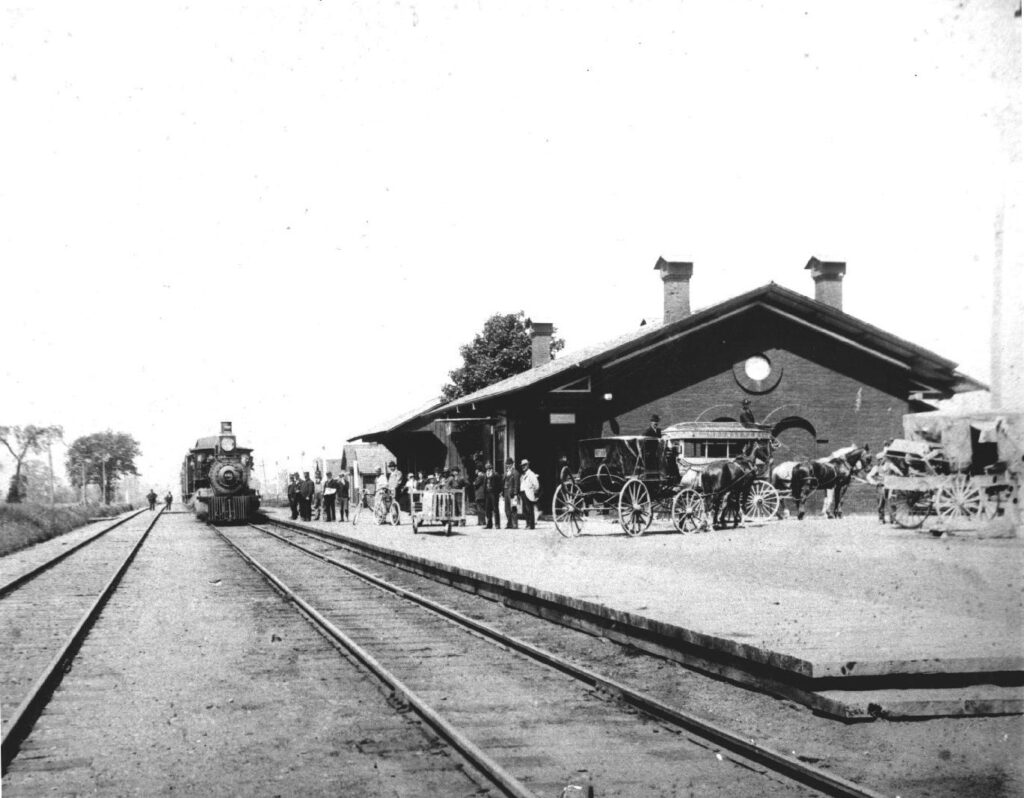
The Grand Trunk station at Colborne, Ontario was one of relatively few made from brick instead of stone in 1856, photographed circa 1910. An identical station was preserved in neighbouring Brighton. 
The Grand Trunk station at Kingston was built larger than the others on the central division. It had a second floor contained within a Mansard-style roof. Courtesy of the Ingenium Digital Archives. 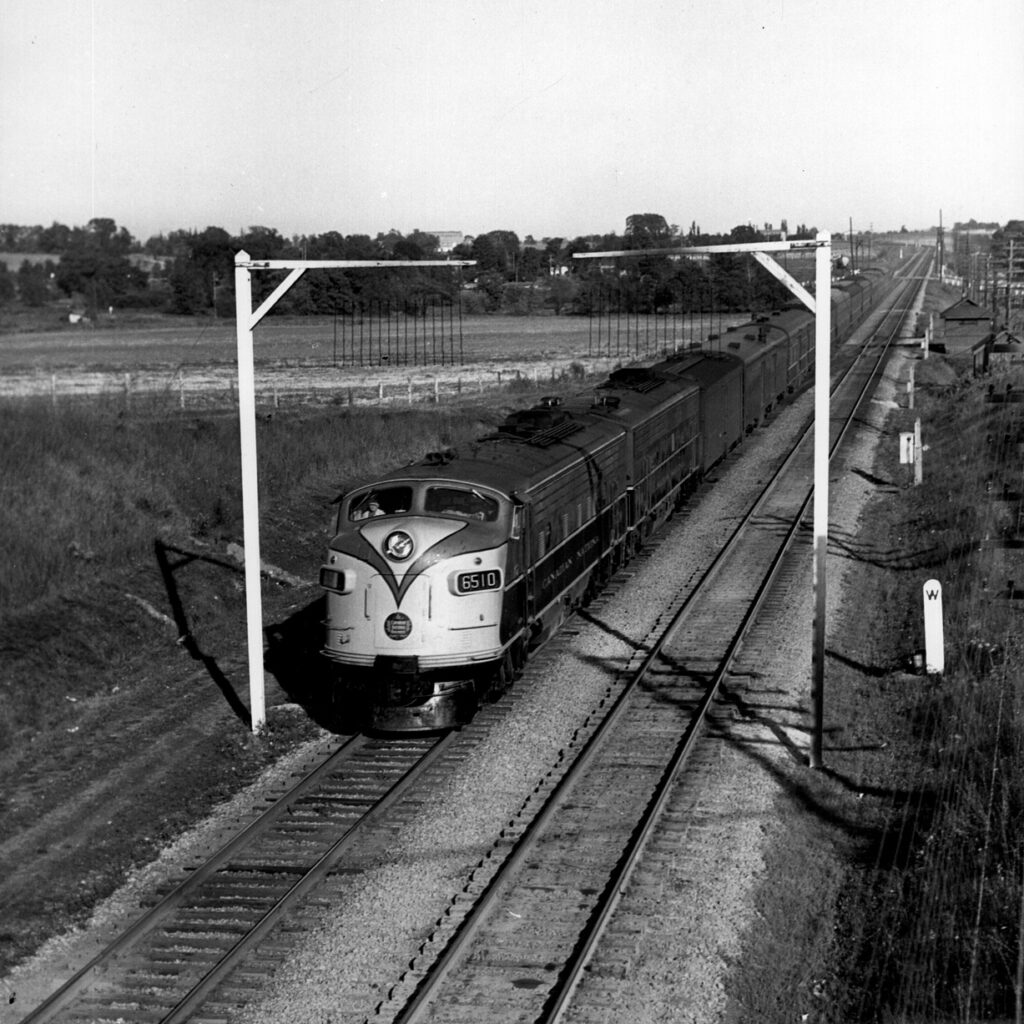
Even as late as 1957, the Toronto-Montreal line’s Grand Trunk heritage is visible in the tombstone-style concrete whistle post (and possibly the wooden telltales) seen from Brock Street in Whitby. Courtesy of the Ingenium Digital Archives. 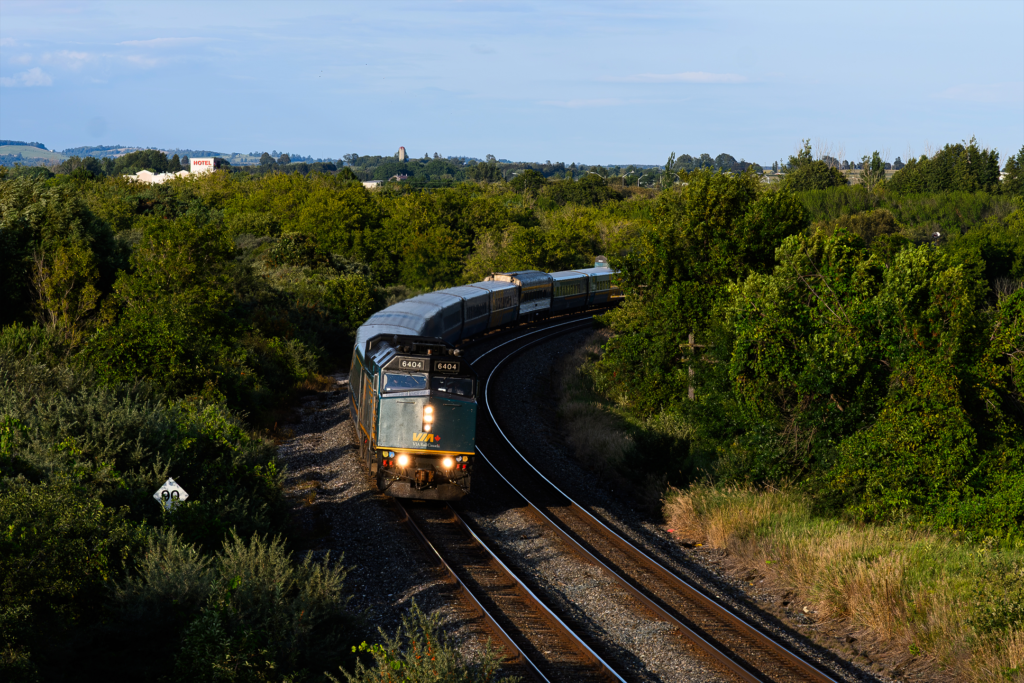
In modern times, several VIA trains and countless CN freight trains use the Grand Trunk Toronto-Montreal line daily. This section in Bowmanville was realigned in 1903. Photo by author.
In its early years the Grand Trunk was flexing its considerable financial backing from England. Most other railways in North America followed a method of construction in which they were built as cheaply as possible with the idea that future profits would fund upgrades later on. Where most other railways in North America were building all-wooden passenger stations at the time, the Grand Trunk made every station on the Toronto – Montreal line west of the Quebec border out of expensive limestone and occasionally brick. They all followed a handful of similar plans designed by architect Francis Thompson, except for the station at Kingston which had a second floor and a Mansard-style roof. Most of the original stations on the Toronto – Montreal line were gradually replaced or demolished over time. At time of writing, the only exceptions are the ones in Port Hope, Brighton, Napanee, Ernestown, Kingston, and Prescott – an impressive number compared to other lines, and partially attributable to their sturdy construction. The Port Hope and Napanee stations are currently used by VIA Rail and are both considered the oldest operating railway stations in Canada, since they opened on the same day. Brighton contained a small railway museum until its owner passed away and now belongs to a new property owner. Ernestown sits in disrepair, Kingston is a ruin, and the Prescott station now contains a local historical society.
The same investment behind its superior infrastructure would propel the Grand Trunk Railway to become the longest railway in the world just a few years after the Toronto – Montreal line opened. Its success directly inspired the idea of a transcontinental railway connecting the provinces of Canada upon our country’s confederation in 1867. Though many parts have been modified over the years, the same line established by the Grand Trunk 170 years ago remains in use and sees countless CN, VIA and GO trains on a daily basis.
Written by Adam Peltenburg
References
Jeanes, D. L. (2006). The Grand Trunk Standard Stations of 1856 and their architect, Francis Thompson. Canadian Rail, (514), p. 239.
London Herald. 1857. “The Grand Trunk Railway.” January 20, 1857. https://www.canadiana.ca/view/oocihm.N_00709_18570120/2.
Guillet, Edwin C. 1963. Pioneer Travel in Upper Canada. N.p.: University of Toronto Press. https://books.google.ca/books?id=_Ps2DwAAQBAJ&dq=grand+trunk+railway+%22august+25+1856%22&source=gbs_navlinks_s.
Grand Trunk Railway. 1858. Proceedings of Fifth Annual General Meeting, Proceedings of the Fifth Annual General Meeting of the Shareholders of the Grand Trunk Railway Company of Canada. Montreal, Quebec: John Lovell, Canada Directory Office. https://www.canadiana.ca/view/oocihm.8_00396_4/1.