

When the Grand Trunk Railway was completed through Darlington Township in 1856, it was originally laid in a nearly straight line parallel and south of modern-day Baseline Road West from Prestonvale Road to Bowmanville Avenue. At the time, the main settlements within Darlington Township were Bowmanville, Hampton, Solina, Tyrone and Enniskillen. The part of Darlington Township between Bowmanville and the east end of Oshawa was too sparsely populated to justify a station when the Grand Trunk first opened between Toronto and Montreal on October 27th, 1856. The first occurrence of a Darlington Station between Oshawa and Bowmanville appears on Grand Trunk timetables between 1880 and 1885. It was listed at mile 293.5 (measured from the GTR’s Bonaventure Station in Montreal), which would put it in the vicinity of McKnight Road. Four trains were scheduled to stop at Darlington Station according to the 1885 timetable, though it specifies that these trains would only stop if they were flagged down. No photographs or depictions of the original Darlington Station are known to exist.
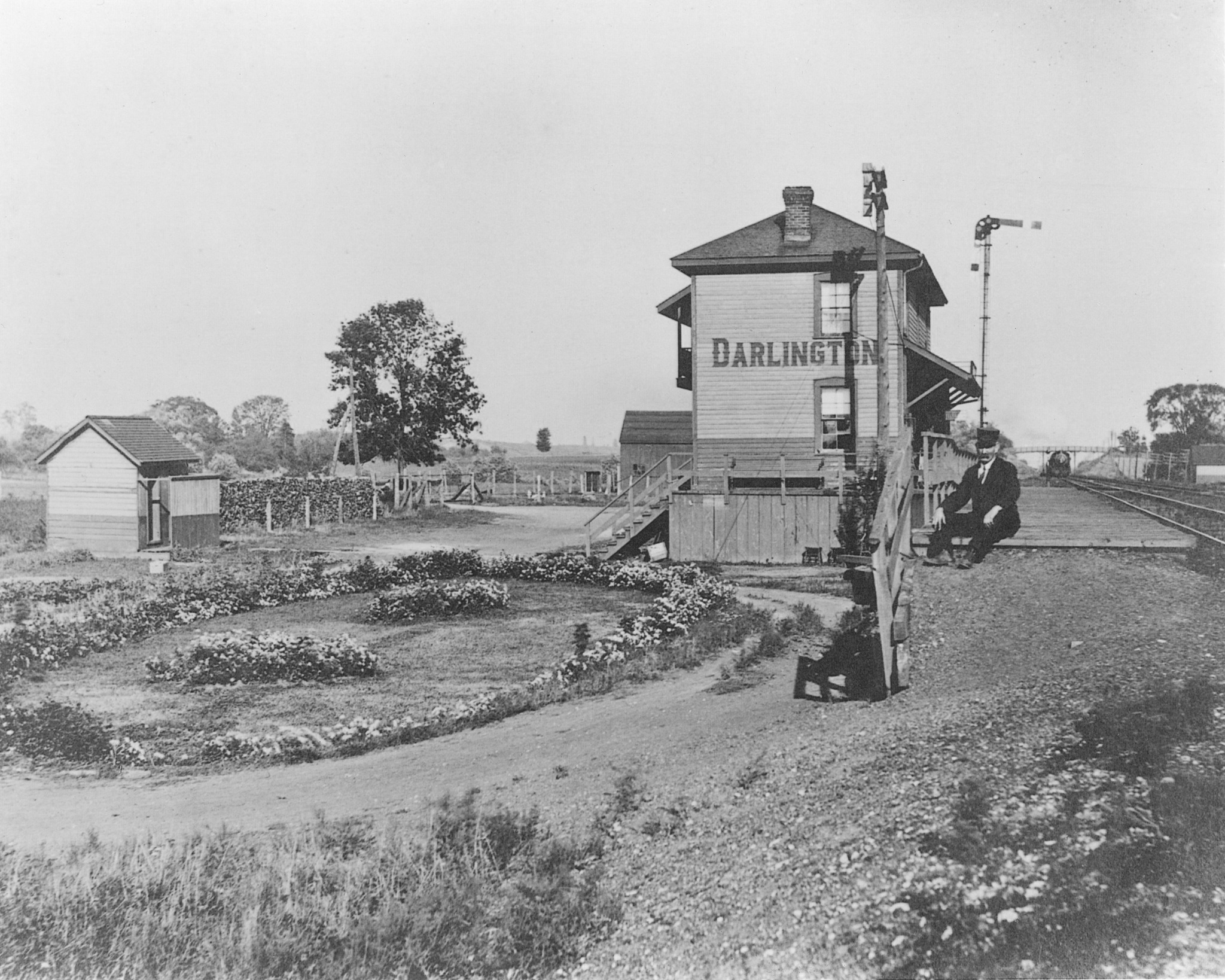
Between the 1883 and 1903, the Grand Trunk undertook a major project to double track their entire mainline between Montreal and Toronto. The final stretch to receive the second main track, between Port Union and Port Hope, required significant earthwork relative to the rest of the line. Several segments of the line were not only regraded, but rerouted over a significant distance between 1901 and 1903. This included the tracks the original Darlington Station was located on which prompted its replacement. While keeping the right-of-way straight might have had its benefits in 1856, it came at the cost of forcing trains directly over a steep hill. The new double-tracked right-of-way was established as much as 1.5 kilometres south of the original one to avoid the hill altogether. The new Darlington Station was built around 1903 at the south end of Solina Road (whose south end was renamed Crago Road after it was split by Highway 401). Like its predecessor, it was located in a rural area with no nearby townsites. The building itself was two storeys tall, with the second floor providing living space for the station agent and his family. Its design could be described as more basic and utilitarian than other Grand Trunk stations built during the same period. Perhaps the most unique aspect was a balcony on the second floor on the opposite side from the platform.
Service to Darlington had reached four daily-except-Saturday trains by 1922, again with the caveat of each of them treating Darlington like a flag stop, while two additional Sunday-only departures were added. This was on the eve of the Grand Trunk’s absorption into the newly-formed Canadian National Railways in 1923. The 1923 CN timetable showed a slight reduction in service by removing two of the daily services in exchange for another pair of Sunday-only departures. Darlington Station disappears from timetables at some point between 1923 and 1940, though the exact reason for its closure and demolition at such an early timeframe is unknown. The station site is now a farmers field and is otherwise inaccessible from nearby public roads.
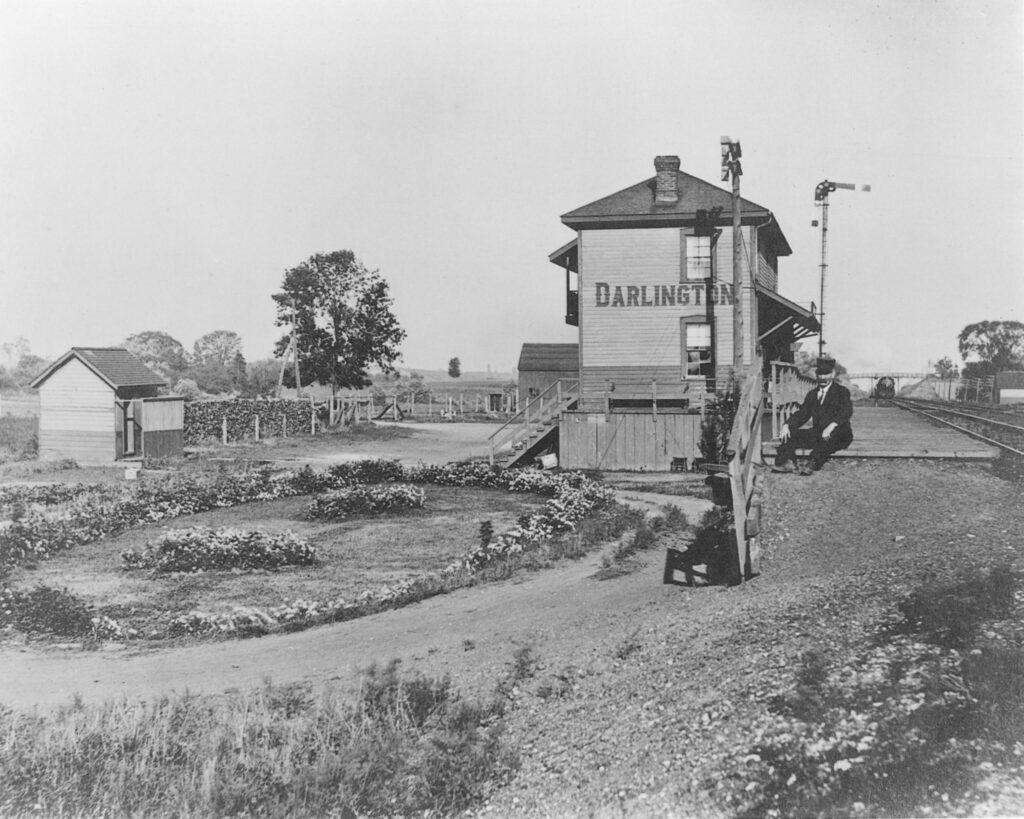
A circa 1900’s photograph, taken looking east towards the 1903 Darlington Station. Note the garden on the left which was tended to by the station agent, who appears to be sitting on the platform. The wooden bridge over the tracks in the distance was Rundle Road (now Park Road). Courtesy of the Canada Science and Technology Museum Archives.
Condensed Station Info:
| Location: | Served By: | Current State: | Date Built: | Date Demolished: |
| Crago Road and Osborne Road | Grand Trunk (~1883 – 1923) Canadian National (1923 – ~1930’s(?)) | Demolished | 1880-1885 (First) 1903 (Second) | 1903 (First) 1920’s-1930’s (Second) |