

Introduction
The Toronto & Nipissing Railway achieved many titles in its short existence, but chiefly among them was that it was the first narrow-gauge railway to open to the public on the continent of North America. Multiple narrow-gauge projects in the United States were beaten to this title by mere months. This railway marked the beginning of a brief period of narrow gauge in the Toronto area lasting about a decade. It was one of three railway companies in the Toronto area promoted by George Laidlaw, a local businessman who was a major proponent of narrow gauge. The Toronto & Nipissing was originally intended to tap into raw resources northeast of Toronto but quickly refocused on a connection with Canada’s first transcontinental railway – a lofty goal it would ultimately never meet. Although the use of narrow gauge on the Toronto & Nipissing only lasted about ten years, its right-of-way from Scarborough to Lincolnville remains in use by commuter passenger trains alongside very few local freight trains. The remainder of the railway to Coboconk has largely been converted into multi-use recreational trails, absorbed by adjacent landowners, or returned to wilderness.
A Question of Gauge
By the mid-1800’s, it was apparent that British North America had fallen behind the United States and Britain in terms of railway development. To financially incentivise domestic railway construction, the Guarantee Act was passed by the Province of Canada in 1849. This piece of legislation would ensure that the interest on half of a given railway company’s bonds were eligible for a guarantee from the government once the railway was halfway to completion. A Board of Railway Commissioners was formed in 1851 to administer the guarantee, but they would decide to add a controversial condition to it just one year later. To qualify for the guarantee, railway companies in Canada were now required to adopt a specific gauge, which refers to the distance between the rails. The committee ultimately settled on five-foot six-inch gauge, which was colloquially known as “provincial gauge” or “Portland gauge” depending on which side of the United States border you were on. This differed from the 4’ 8.5’’ gauge which had rapidly become the standard in the United States. In the ensuing railway boom of the 1850’s a total of three railways would enter the rapidly growing city of Toronto, all of which made use of 5’ 6’’ gauge to take advantage of the loan interest guarantee. They were the Ontario, Simcoe & Huron Railway, the Grand Trunk Railway, and the Great Western Railway. While all three did handle their fair share of local traffic, each one was primarily focused on through traffic between major cities or harbours.
At about the same time, a 37-year-old George Laidlaw arrived in Toronto from Scotland. Once there, he began working as a grain buyer for local distillery Gooderham & Worts which had just started its new complex on Toronto’s waterfront. Its location was specifically chosen not only for its convenient access to shipping on Lake Ontario, but also to the Grand Trunk Railway whose Toronto to Montreal mainline bordered the southern edge of the Gooderham & Worts property. The distillery naturally required a significant volume of grain and other raw materials, much of which could only be sourced from rural areas where either the land hadn’t been cleared or the infrastructure to move said resources did not yet exist. Laidlaw quickly became interested in railways and their potential ability to solve this problem. His search for a cheaper form of railway construction led him to Sir Charles Fox and Carl Abraham Pihl. Both of these individuals were civil engineers from Britain and Norway respectively, who were responsible for the popularization of a narrow gauge measuring 3’ 6’’ in width. Laidlaw became convinced that narrow gauge would be necessary for the technical and financial challenges of a railway into the less developed areas northeast and west of Toronto, and he published two pamphlets arguing in favour of its adoption in 1867. Laidlaw’s vision involved two separate narrow gauge railway companies – one leading to the northeast from Toronto called the Toronto & Nipissing Railway and another to the northwest called the Toronto, Grey & Bruce Railway. Another one of Laidlaw’s narrow-gauge projects called the Credit Valley Railway began to take shape at the same time to compliment the Toronto, Grey & Bruce, though it took much longer for work to begin and by that point it ultimately adopted 4’ 8.5’’ standard gauge instead.
By the time of Canada’s confederation on July 1st, 1867, the process of establishing the Toronto & Nipissing Railway was already set into motion. The company was incorporated on March 4th, 1868, to construct a railway from Toronto to an unspecified point on Lake Nipissing – a distance of approximately 200 miles. The full scope of the railway remained somewhat unclear in the legislation and among its promoters, but the company’s prospectus would clear up some of the confusion a year later. The first section of the railway was to be built from Toronto to Coboconk, a distance of approximately 85 miles. Additionally, there was to be an 18-mile branch line connecting the first section to Lindsay. The second section of the railway was to extend the remaining 115 miles from Coboconk to Lake Nipissing. Not only would this section be built through considerably more difficult terrain than the first, but it would also exist in a remote area relatively devoid of settlements. The company assured potential investors that this section would only be built if it received substantial support from the government. While the vicinity of Lake Nipissing would eventually become a major thoroughfare for Canada’s transcontinental railway – the provisions for which were laid out in the British North America Act of 1867 – it would be several years before the route was surveyed. As a result, there is no mention of the transcontinental railway in the Toronto & Nipissing’s prospectus which instead focused on tapping into a vast source of lumber:
“Nevertheless, the Company feel assured that [upon] the first section being successfully completed, the remaining section will immediately receive aid from the Government to the extent necessary to secure the construction of the line to the ultimate terminus of Lake Nipissing – thus ensuring to the proprietors of the first section the practically unlimited timber traffic, as well as the general business of an immense new territory of twenty thousand square miles”.
Construction Begins
The sod-turning ceremony of the Toronto & Nipissing Railway was held on October 16th, 1869, in a forest clearing near the small settlement of Cannington where a stop on the railway was planned. Multiple figures involved in the railway’s formation were in attendance including directors of the company and local politicians. The first sod was turned by John Sandfield MacDonald, the first premier of the Province of Ontario. In the official photograph of the event Laidlaw stood alongside William Gooderham, Jr., who was also listed as a director of the Toronto & Nipissing. Gooderham & Worts stood to benefit from the railway and Gooderham used his influence to promote it alongside Laidlaw. In addition to several others, they were joined by John Shedden and Edmund Wragge. Shedden was a cartage agent and contractor with strong ties to the Grand Trunk. His firm was already responsible for the construction of the Grand Trunk’s large grain elevator on the Toronto harbour, and it would soon be tasked with the construction of Toronto’s second Union Station. Wragge was a civil engineer who had previously worked alongside Sir Charles Fox on the Cape Town and Wellington Railway in South Africa.
While the railway was being surveyed, the first issue that needed to be sorted out was their right-of-way in Toronto. At this point in time, the main rail corridor into the city was right down the middle of the Esplanade. The Grand Trunk Railway had pressured the city into allowing it to occupy 40 feet of that street for its tracks about two decades earlier. The tracks ran down the middle of the Esplanade with 30 feet on either side dedicated to pedestrians and carriages. By the time the Toronto & Nipissing arrived on the scene, nearly all 40 feet were taken up by the Grand Trunk. To work within that restriction, it was decided that the railway’s southern terminus would be located at the east end of the Esplanade at Berkeley Street. The property on the north side of the Esplanade and the east side of Berkeley previously belonged to Toronto’s third jail which was vacated earlier in the 1860’s. This would soon become the site of the Toronto & Nipissing’s main freight and passenger station for Toronto, as well as a six-stall roundhouse for storing and maintaining locomotives. Two additional tracks connecting to the turntable would lead to a pair of car sheds for rolling stock maintenance.
The original survey called for the Toronto & Nipissing right-of-way to be built parallel along the north side of the Grand Trunk from Berkeley Street to a point west of Scarborough. To avoid the full cost of building a redundant section of railway between those points, officials from the T&N negotiated to share the Grand Trunk’s right-of-way instead. This would be achieved by laying a third rail inside the existing rails of the Grand Trunk, accommodating trains of both gauges simultaneously. The work would be conducted by the Grand Trunk under the supervision of C. J. Brydges and would include a joint passenger station where the Toronto & Nipissing right-of-way split off in Scarborough. In return the Grand Trunk would charge the Toronto & Nipissing a regular fee for the use of its tracks. Some contemporary sources suggest that Shedden’s connections with the Grand Trunk helped make this deal possible.
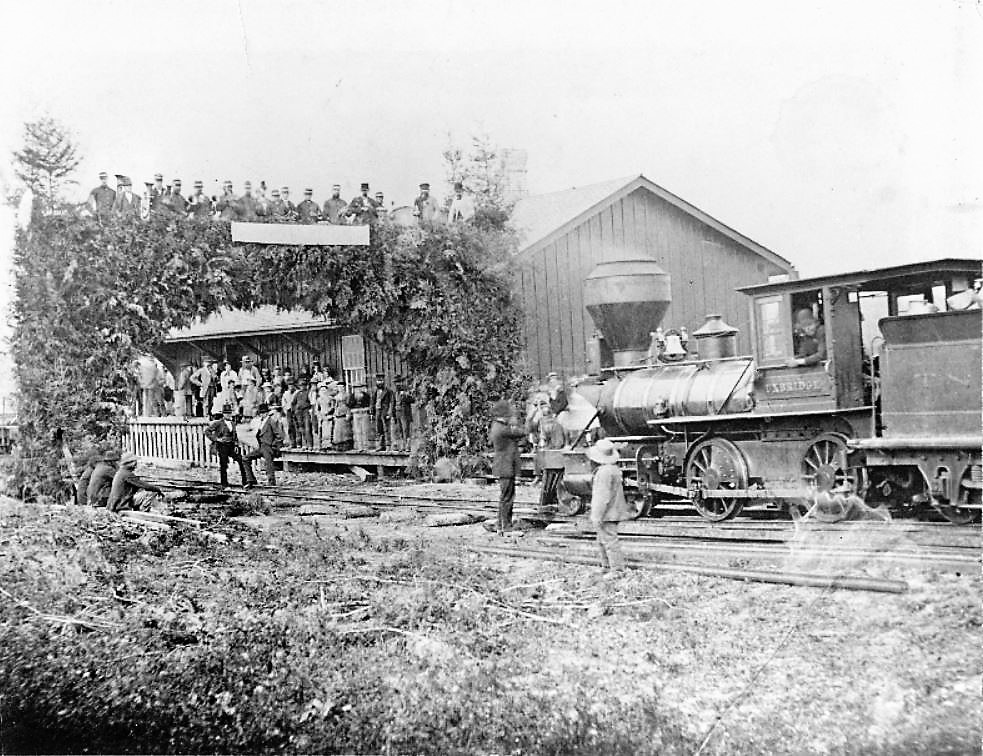
A slim majority of the Toronto & Nipissing’s locomotives were manufactured by the Avonside Engine Company in Bristol, England. The rest were produced domestically by the Canadian Engine & Machinery Company, a predecessor of the Canadian Locomotive Company in Kingston, Ontario. John Shedden The very first locomotive to be delivered to the Toronto & Nipissing arrived from Avonside in September of 1870. Underscoring William Gooderham’s influence on the railway, this locomotive was given the moniker Gooderham & Worts. Each locomotive on the Toronto & Nipissing roster was similarly given a name, but they were mostly after towns along the route or directors of the company. Another four locomotives would arrive from Kingston between October 1870 and March 1871. Much like the earlier Avonside locomotive, their first assignments likely involved assisting in the railway’s construction. Two more were delivered in May of 1871, named Uxbridge and Eldon respectively. Larger engines started to arrive at the Toronto & Nipissing towards the end of that year and into early 1872, the most unusual of which was an Avonside-built 0-6-6-0T. This wood-burning engine, named Shedden, was designed to operate in both directions without needing to be spun around on a turntable. In total, the Toronto & Nipissing would come to own twelve locomotives – the last of which would arrive in 1873.
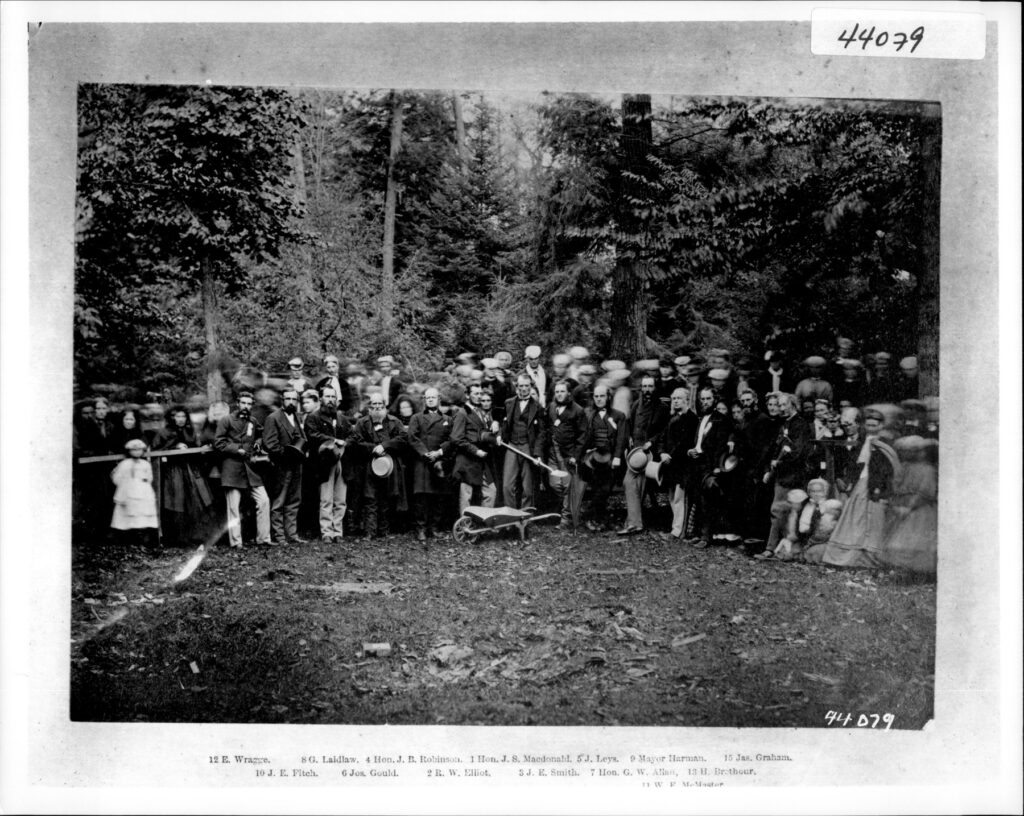
The founders of the Toronto & Nipissing Railway pose for a commemorative photo at the sod-turning ceremony on October 16th, 1869. 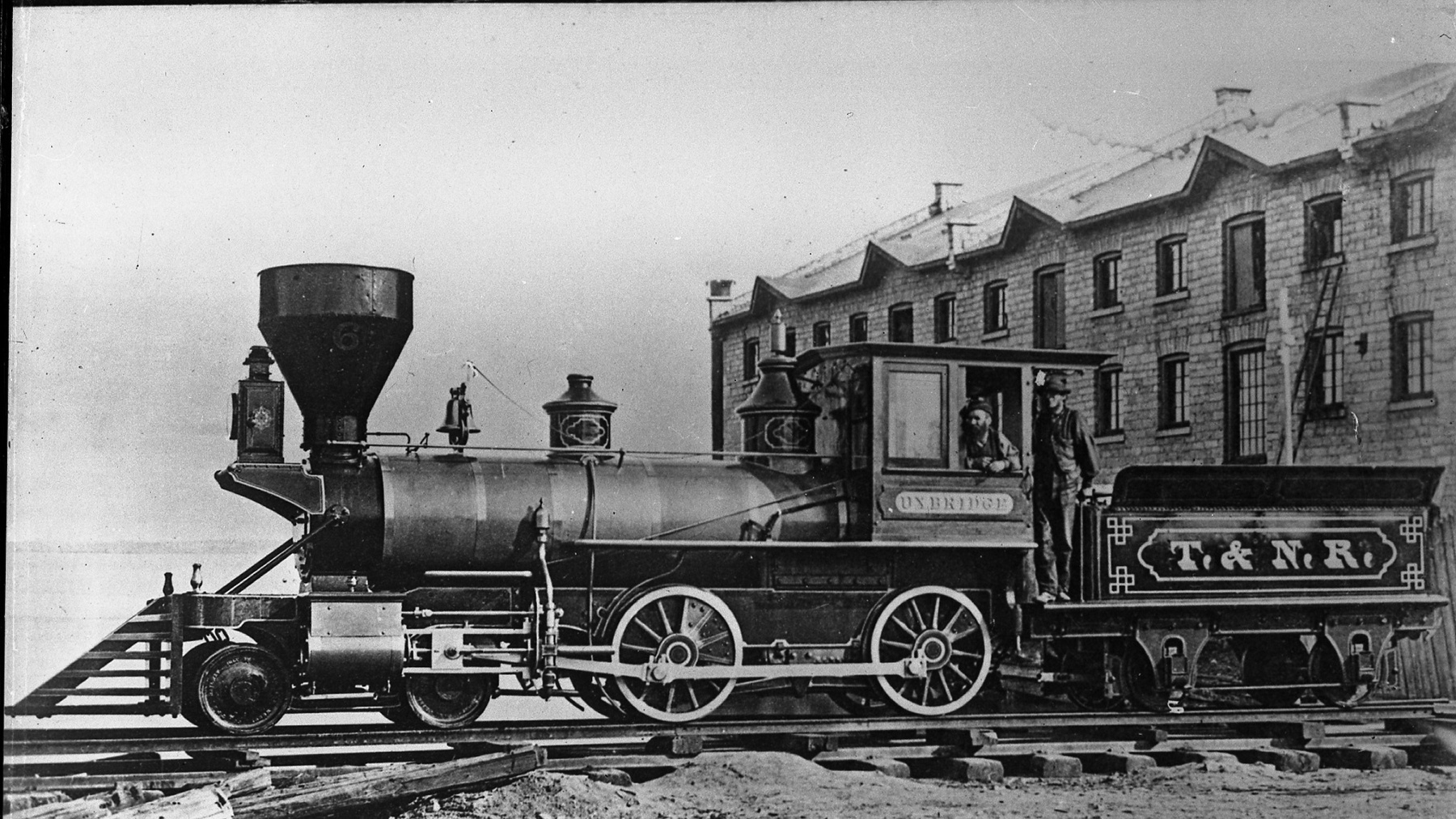
A circa 1870’s photograph of Toronto & Nipissing locomotive no. 6, “Uxbridge”. 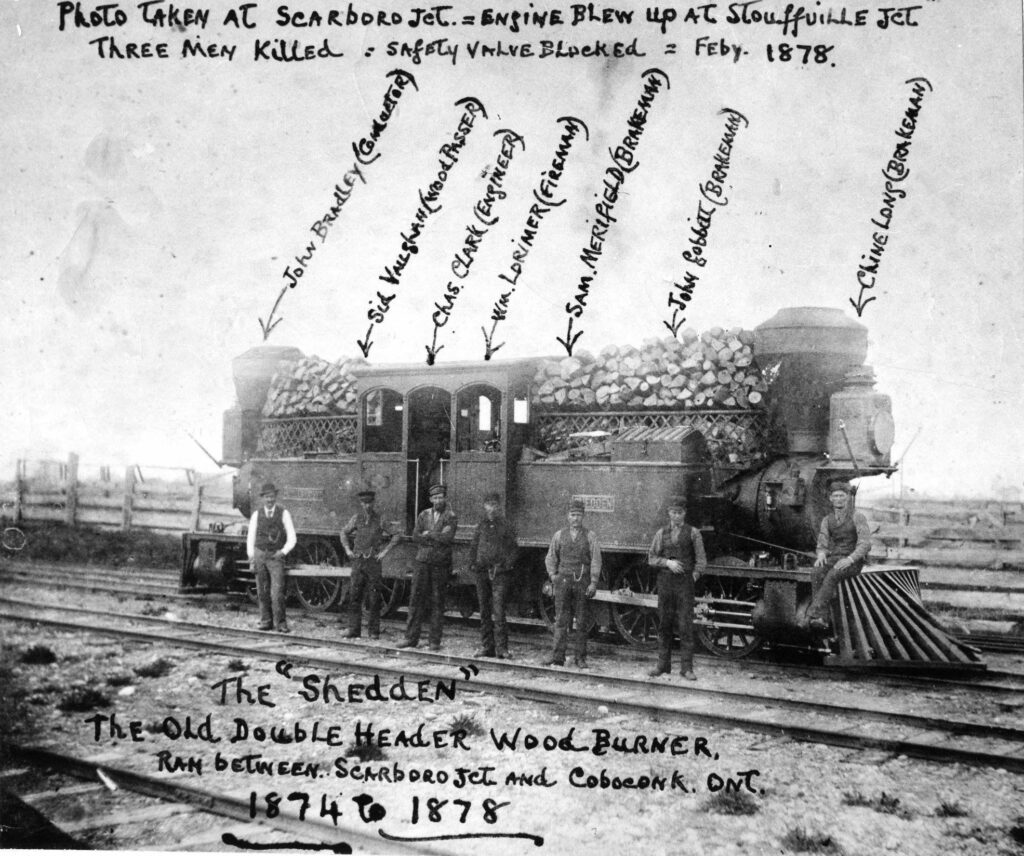
Toronto & Nipissing 9, “Shedden”, the sole 0-6-6-0T locomotive on the roster, photographed with crew at Scarborough Junction in the mid-1870’s. 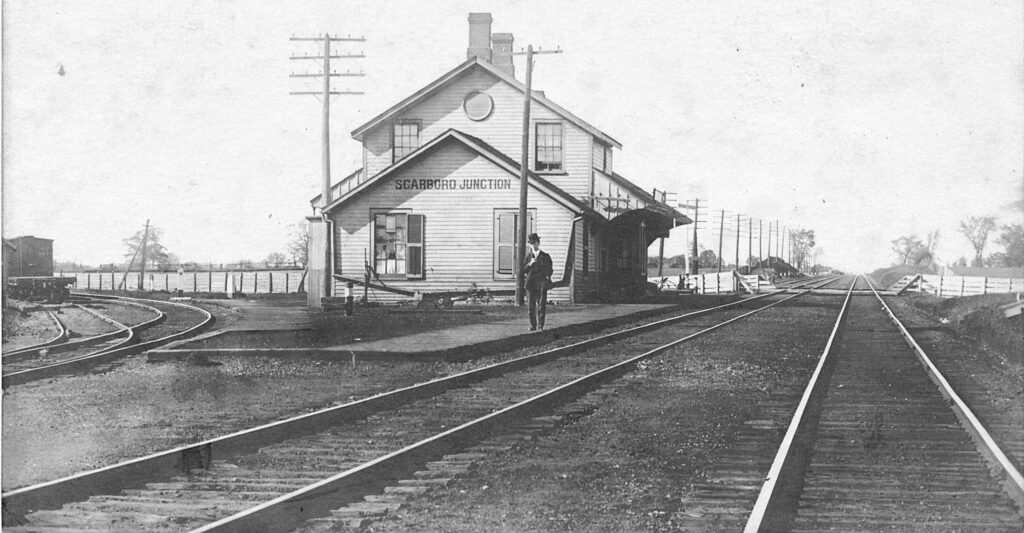
Looking east towards Scarborough Junction Station circa 1910. The double-track Grand Trunk mainline is in the foreground while the former Toronto & Nipissing curves off to the left. Courtesy of the Ross Gray Collection.
First of its Kind
The Toronto & Nipissing built its railway through the villages of Agincourt, Unionville, Markham, Stouffville, and Uxbridge. This work was done throughout the year 1870 and the first half of 1871. The first semi-official instance of revenue freight carried by the Toronto & Nipissing technically occurred on March 28th, 1871, when the owner of a clothing store in Markham had new inventory brought to Scarborough Junction by horse and carriage, then the rest of the way on a flatcar pulled by a Toronto & Nipissing construction train. Rails were first laid to Uxbridge on April 18th, 1871, after which the locomotive Eldon brought the very first train into town on April 27th. This was also Eldon’s first run since it was delivered to the T&N. The train included four flatcars of rails and a boxcar which William Gooderham Jr. and Edmund Wragge rode in to inspect the line. Now that such a train trip was possible, it was time to show it off to the rest of the interested parties. On May 24th, the locomotive Gooderham & Worts pulled a special passenger train from Toronto to Uxbridge and back. William Gooderham Jr, John Shedden, city officials from Toronto and executives of the Grand Trunk Railway were on board. Since the turntable hadn’t been built at Uxbridge yet, the locomotive had to push the train in reverse all the way to Stouffville where another locomotive facing the proper direction could couple onto the rear of the train.
The very first revenue passenger service over the Toronto & Nipissing began operating on July 13th, 1871; the event which establishes it as the first railway of its kind to open in North America. From that day onward a train would leave Uxbridge daily at 5:30 am, arriving in Toronto at 8:50 am. The equipment used on this train would layover at the roundhouse in Toronto for six hours before leaving Toronto for Uxbridge at 3:15 pm. The first revenue train was met with relatively little fanfare and a considerably delayed “grand opening” ceremony was held two months later on September 14th. Once again, this featured a special train that was to travel the opened section of the line from Toronto to Uxbridge. This time, the train consisted of ten passenger cars which required two locomotives to pull their weight. Locomotives #4 and #5, Rice Lewis & Son and Joseph Gould respectively, were assigned to the task. The train left a decorated Berkeley Street Station at 9:00 am and arrived in Uxbridge at 12:30 pm. Each station along the way was similarly decorated for the occasion. Shortly after the passengers detrained in Uxbridge, the marching band of the 10th Battalion of the Royal Grenadiers played See the Conquering Hero Comes. After a large banquet with speeches and toasts, the guests boarded the train again at 3:30 pm and arrived in Toronto at 6:00 pm.
With revenue now being generated south of Uxbridge, construction quickly pushed north towards Coboconk. The Toronto & Nipissing was opened to Sunderland in November of 1871, reaching Lorneville Junction (then called Midland Junction) a month later. It was at the latter location where the T&N crossed the Midland Railway at grade. Interchange tracks were built around the junction, though as with most other roads the gauge difference would hinder interchange. Construction was delayed through the winter but pressed on once the ground thawed. It reached the small community of Victoria Road in August 1872. Service to Coboconk, the last stop on the first segment of the Toronto & Nipissing, officially began on November 26th, 1872. The first phase of the railway was now complete.
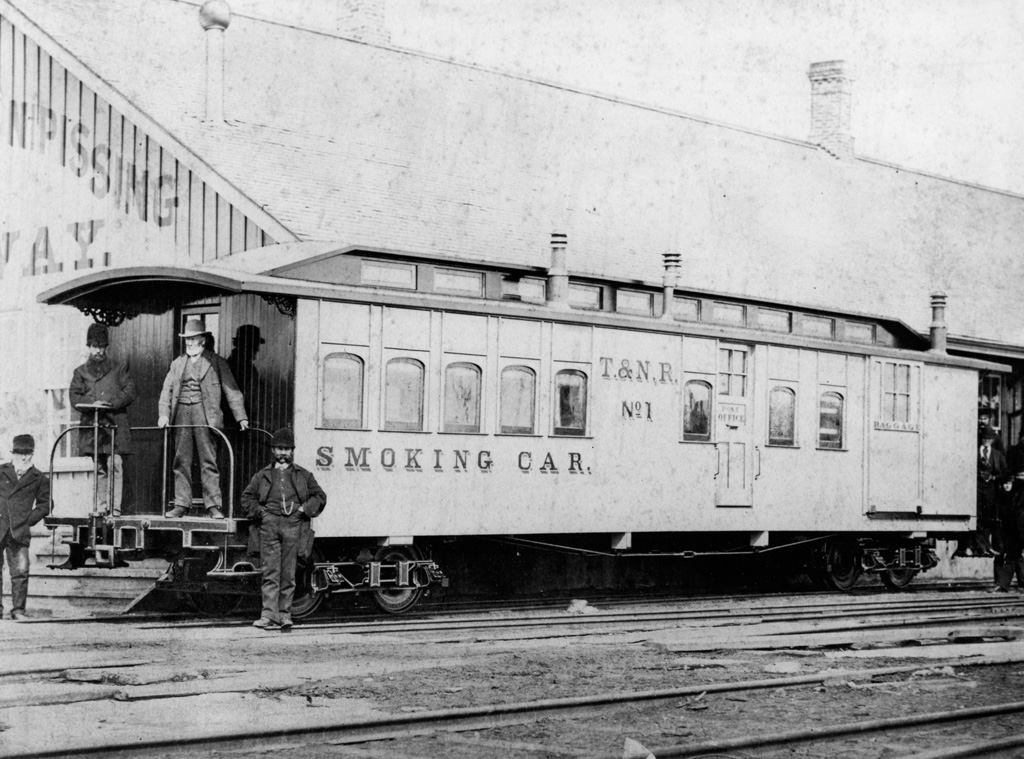
A circa 1870’s photograph of Toronto & Nipissing smoking car no. 1 with part of the Berkeley Street Station visible behind it. 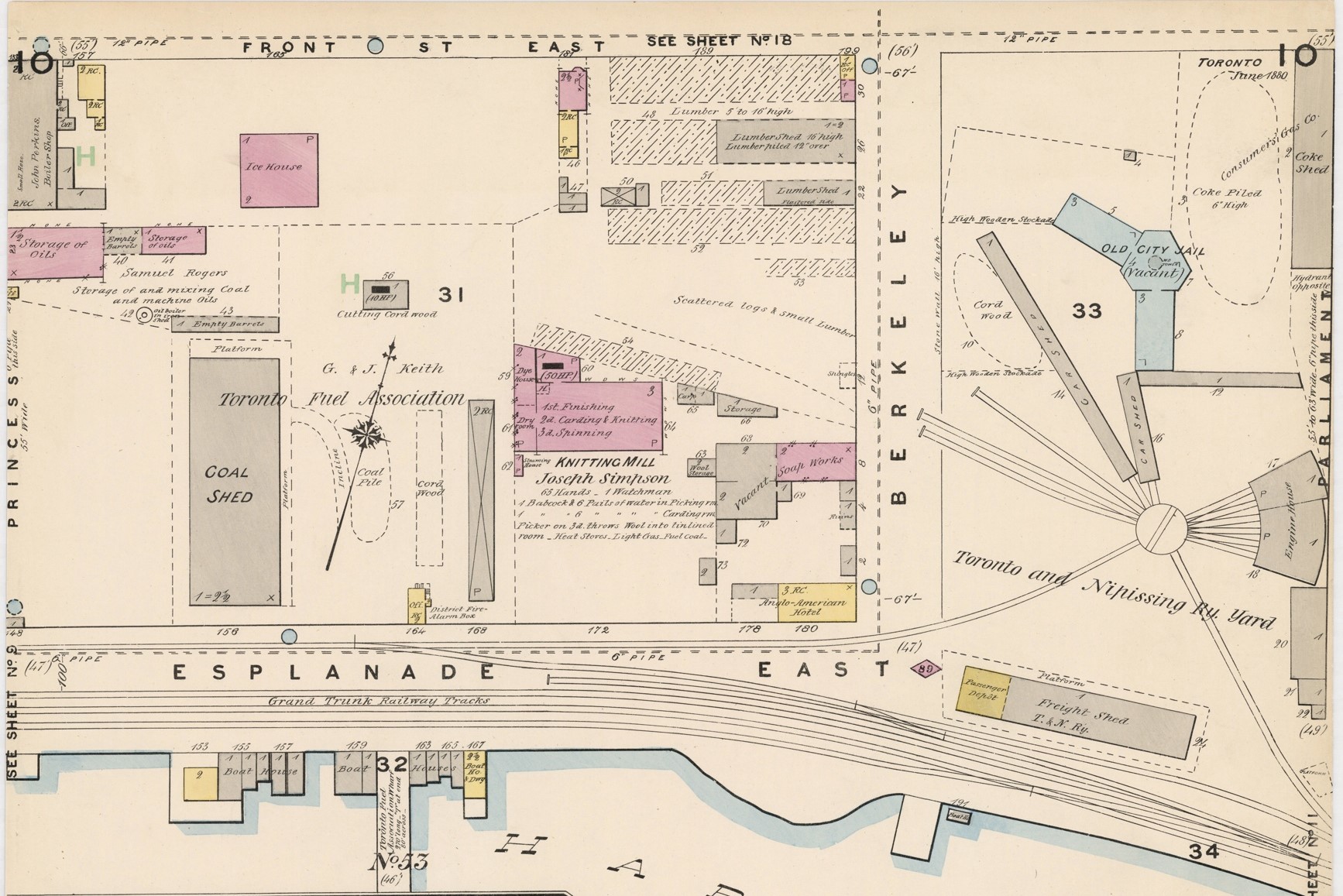
A circa 1880 fire insurance map of Toronto showing the Toronto & Nipissing roundhouse and Berkeley Street Station on the right. 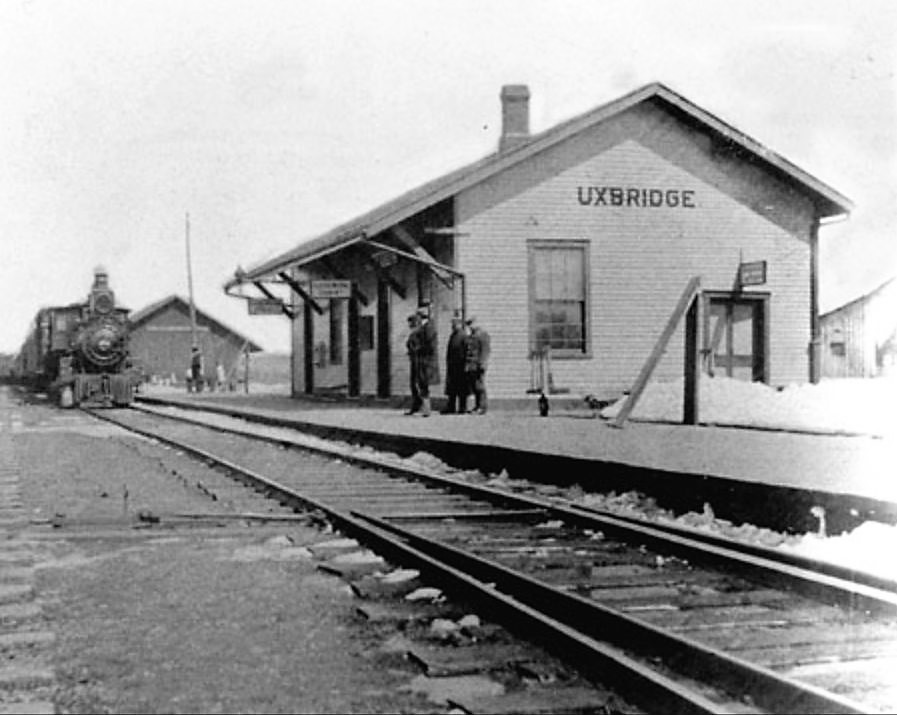
The original Uxbridge Station in a photo taken shortly after it was built in 1871. A Toronto & Nipissing locomotive pulling a passenger train is about to stop at the station. Courtesy of the Port Perry/Scugog Township Heritage Gallery. 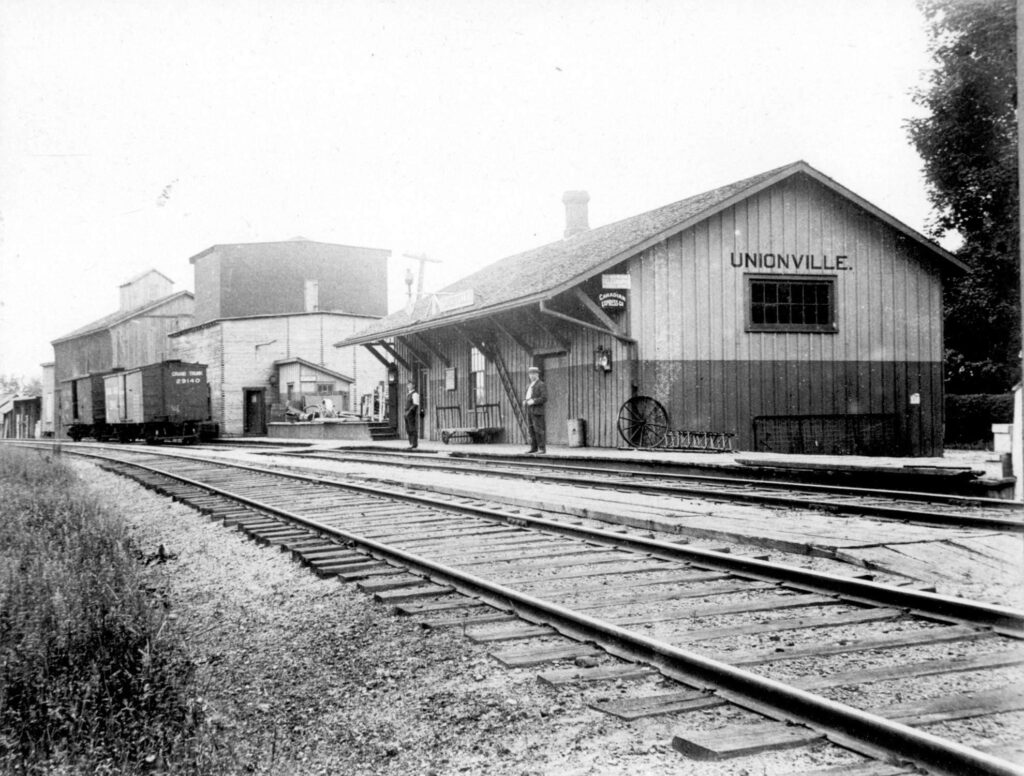
A circa 1907 postcard of Unionville Station during the Grand Trunk era. Courtesy of the Ross Gray collection.
The Lake Simcoe Junction Railway
The aforementioned challenges associated with laying tracks beyond Coboconk would be difficult for any railway to surmount under normal circumstances, but the events of 1873 would be far from normal. Misfortune first befell the Toronto & Nipissing when John Shedden was pinned between a train and the station platform at Cannington and died on May 16th, 1873. He was succeeded by William Gooderham Jr. as president of the company. Shortly thereafter, a cascade of stock market crashes in Europe and the United States, which became known as the Panic of 1873, would cause a lasting economic depression. Without assistance from the federal government, any hope of the Toronto & Nipissing extending beyond Coboconk in a timely manner essentially evaporated. Where the railway was previously struggling to move the volume of freight it needed to, freight was now drying up at a critical time when much of the railway’s infrastructure needed to be fixed up or replaced.
Things were largely quiet on the Toronto & Nipissing until financial conditions marginally improved around the mid-1870’s. In late 1875, a survey was conducted from Coboconk to Norland. A far more conservative goal than Lake Nipissing to be sure, but nevertheless a sign of optimism towards the future. The Toronto & Nipissing also took the opportunity to revisit its plans for a “feeder” line – one that split off the main branch. The Fenelon Falls Railway was chartered by George Laidlaw and other T&N directors in 1870 for this purpose, but it was never built and the idea was pursued by Laidlaw as a separate venture – the Victoria Railway. Simultaneously, those living directly between the Toronto & Nipissing and the Northern Railway systems felt they were too far from either. There was pressure on the Toronto & Nipissing to build a branch line into this region as early as 1872, when business leaders from the surrounding townships met in Sutton and appointed a committee to discuss the construction of a branch of the Toronto & Nipissing from Stouffville to Jackson’s Point. The Toronto & Nipissing officials were impressed enough with the proposal that the route was surveyed almost immediately in March of 1872. The topography was found to be more than suitable for a railway and almost exactly a year later, on March 29th, 1873, the Lake Simcoe Junction Railway (LSJR) was incorporated. Unfortunately, further progress beyond this point was also significantly delayed by the Panic of 1873.
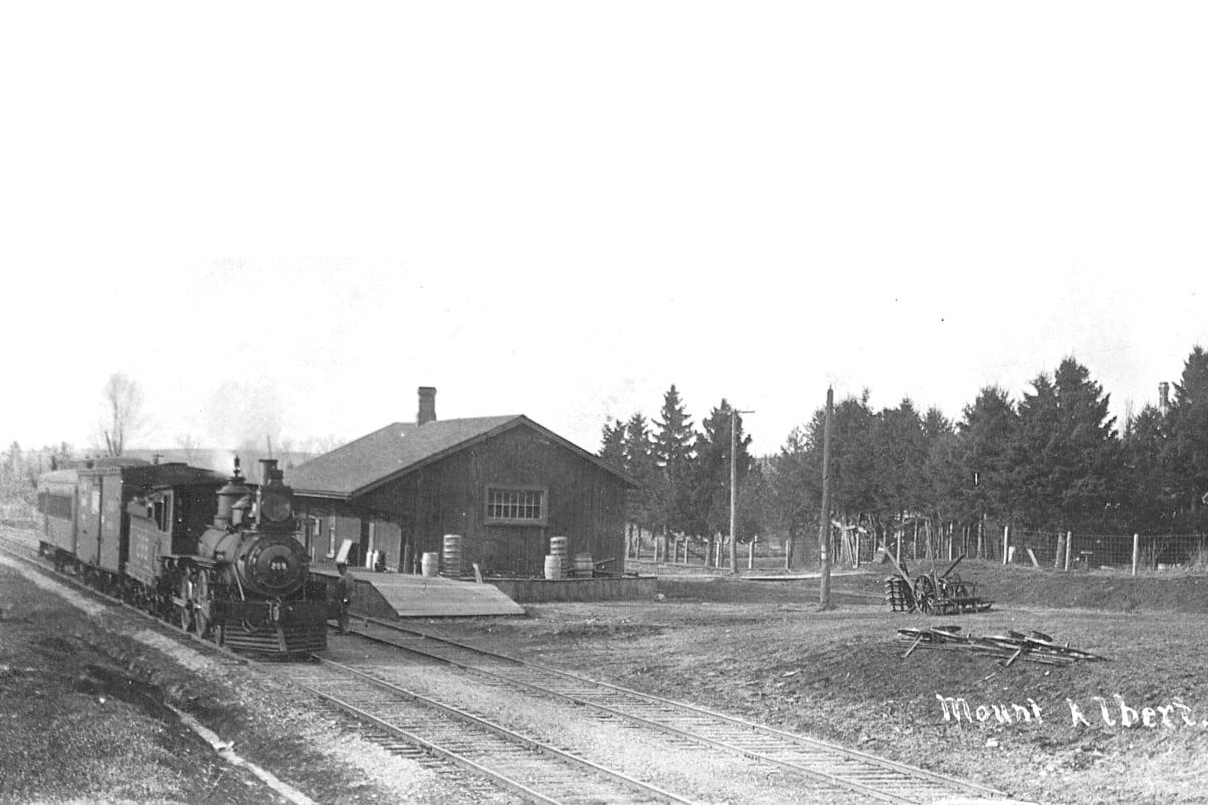
The Lake Simcoe Junction Railway was essentially a paper company; a railway that existed on paper but would have no locomotives or rolling stock of its own. The LSJR would enter into a lease agreement with the Toronto & Nipissing who would operate it as an extension of their system, handling both its construction and everyday operations. Progress remained slow through the mid-1870’s, and a more detailed survey was not conducted until late 1875. This survey called for the construction of five passenger stations: Ballantrae, Vivian, Mount Albert, Ravenshoe (later Brown Hill), and Sutton. Both Stouffville and Sutton would receive two-stall roundhouses and turntables similar to the one at Coboconk. Mount Albert and Sutton would receive water towers similar to the one at Cannington. Where the rails ended in Jackson’s Point, there would be a dock capable of holding four eight-wheel freight cars. The first train led by T&N no. 6 Uxbridge made its way to a decorated Sutton Station in October of 1877, though regular passenger service would not commence until December 10th. The first revenue train left Sutton at 7:00 a.m. and arrived at Stouffville Junction at 8:45 a.m.
Fate of the Toronto & Nipissing Railway
Despite their best efforts, the Toronto & Nipissing struggled to maintain profitability. Either to attract investors, government support, or a combination of the two, there was an uptick of progress towards the second phase of the line. Another survey was conducted beyond Norland to Moore’s Falls, about 12 miles from Coboconk, in late 1877. The idea was that a steamboat service would operate beyond Moore’s Falls to Minden. The railway would pick up again from Minden to Trading Lake, 48 miles from Coboconk. An all-rail route was investigated but the stretch between Moore’s Falls and Minden was determined to be not only too costly, but also too close to the Victoria Railway. Surveys continued as late as 1879 but to no avail, as the Toronto & Nipissing simply couldn’t afford to extend their system. In April of 1880, William Gooderham Jr. also picked up the charter of the stagnant Toronto & Ottawa Railway, which was formed by unaffiliated individuals to connect its namesake cities after the Ontario & Quebec Railway initially failed to materialize in the early 1870’s. Though like the extension northward, the Toronto & Nipissing had no means to built anything approaching the scale of the Toronto & Ottawa Railway.
The demise of the Toronto & Nipissing Railway has a great deal to do with one of its neighbours, the Midland Railway. Like the T&N, the Midland was going through its own financial struggles. It and the Grand Trunk had already made the switch from broad gauge to the 4’ 8.5’’ standard gauge by this point. The Toronto & Nipissing was feeling the effects of the problems that came with a difference of gauge at interchange points but was unable to fund its own conversion to standard gauge. Executives of the Midland Railway identified that they were surrounded by unprofitable branch lines that could be more profitable as a single entity, one that would require the Toronto & Nipissing’s important connection to Toronto. A proposal by the Midland Railway to purchase the Toronto & Nipissing was made in mid-1881. During the negotiations, the Midland Railway agreed to finance the Toronto & Nipissing’s conversion to standard gauge. Towards the end of negotiations in January 1882, the shareholders and bondholders were presented with a proposed merger between the following companies.
- Toronto & Nipissing Railway (Toronto – Coboconk)
- Whitby, Port Perry & Lindsay Railway (Whitby – Lindsay)
- Victoria Railway (Lindsay – Haliburton)
- Toronto & Ottawa Railway (Toronto – Ottawa, not built)
- Grand Junction Railway (Belleville – Peterborough)
- Midland Railway (Port Hope – Midland)
Before the negotiations were even finished, work began on turning the five (plus one) separate lines into a coherent system. It was decided that the charter of the Toronto & Ottawa Railway would be altered to instead create two key rail connections that would form a continuous “main” line from Toronto to Belleville using parts of the Toronto & Nipissing, Whitby, Port Perry & Lindsay, Midland, and Grand Junction Railway. In September 1881, the Toronto Globe reported that a survey was conducted from the Toronto & Nipissing near Wick (Blackwater) to Manilla Station on the Whitby, Port Perry & Lindsay, with the assumption that the new line would be open later the same year. This was one of the two new sections made with the Toronto & Ottawa charter, the other being between Omemee and Peterborough. The first through passenger train ran from Peterborough to Toronto on December 15th, 1881. The merger between the aforementioned companies went into effect on April 1st, 1882, with them all now operating under a single entity called the Midland Railway of Canada. To celebrate the merger, a special train left Toronto at 4:55 p.m. and traversed the combined system.
It’s important to bear in mind that when all of this was happening, the chairman of the bondholders’ committee of the Midland Railway was none other than Sir Henry Tyler of the Grand Trunk Railway. Many of the other members of the committee were also affiliated with the Grand Trunk. 1881 was the year that a new syndicate took on building the pacific railway, and individuals associated with that syndicate had reactivated the Ontario & Quebec Railway’s charter. In response, the Grand Trunk began snapping up all of southern Ontario’s feeder lines. The Midland Railway was leased to the Grand Trunk just less than two years after the merger, effective January 1st, 1884. While from this point the Grand Trunk operated it as their “Midland Division”, it took until 1893 for the Midland Railway to be fully absorbed.
The first major abandonments of the Toronto & Nipissing system came after the formation of Canadian National. The Lake Simcoe Junction Railway proved to be the weak link, with the first abandonment occurring from Stouffville to Zephyr in 1928. Trains would reach the rest of that line via a spur off CN’s Bala Subdivision. The very end of the line from Sutton to Jackson’s Point, long used to transport ferry passengers in summer and ice for refrigeration in winter, was abandoned the following year. The rest of the system remained stable until private automobiles and trucking started to eat away at railway business in the mid-20th century. The very end of the Toronto & Nipissing from Lorneville Junction to Coboconk was abandoned in 1965, followed immediately after by Woodville to Lorneville Junction in 1966. The remainder of the LSJR was officially abandoned in 1979. This was followed by the main T&N line north of Blackwater being abandoned in 1986, then south of Blackwater to Uxbridge in 1991. All of these segments except north of Woodville or the parts of the LSJR abandoned before 1979 were turned into public recreational trails.
Today, the only segment of the Toronto & Nipissing still actively in use is now the GO Transit Stouffville Line. The southern end of that line is also occasionally used by freight trains to access the GECO spur in Scarborough. Part of the line beyond Stouffville to Uxbridge was served by CN into the 1990’s, but after that was operated by the York-Durham Heritage Railway for about three decades. The YDHR ran their last train at the end of 2023 and the future of this stretch of track is uncertain at time of writing. Two original Toronto & Nipissing passenger stations dating to the line’s opening to Uxbridge in 1871 still remain in existence at Unionville and Markham, with the latter being presently used as the Markham GO Station. The T&N station at Victoria Road presently exists as a private residence.
Written by Adam Peltenburg
References
Clarke, Rod. 2007. Narrow Gauge Through the Bush: Ontario’s Toronto Grey & Bruce and Toronto & Nipissing Railways. N.p.: R. Clarke and R. Beaumont.
“The Toronto and Nipissing Railway Company.” 1869. The Monetary Times and Trade Review 2, no. 35 (April). https://www.canadiana.ca/view/oocihm.8_06969_87/10.
The Canadian Illustrated News. 1871. “The Toronto and Nipissing Railway.” October 7, 1871. https://www.canadiana.ca/view/oocihm.8_06230_101/7.
“Toronto & Nipissing Railway.” 1871. The Monetary Times and Trade Review, no. 19 (November). https://www.canadiana.ca/view/oocihm.8_06587_19/9.
“Toronto & Nipissing Railway.” 1872. The Monetary Times and Trade Review 6, no. 12 (September). https://www.canadiana.ca/view/oocihm.8_06587_64/10.
“Toronto & Nipissing Railway and the Consolidations.” 1881. The Monetary Times and Trade Review 15, no. 27 (December). https://www.canadiana.ca/view/oocihm.8_06587_548/21.
The Toronto and Ottawa Railway. 1880. https://www.canadiana.ca/view/oocihm.27714/5.